Our brain reacts to shame as a threat, shutting down parts of our nervous system. It threatens to activate the frontal lobes that control our executive functioning because it feels like we are in imminent danger. These vital organs monitor and organize our thoughts and feelings, preventing them from going to the outfield and functioning on all gears. Our frontal lobes manage impulse control and problem-solving skills, expressive language, and memory. A continuous and repetitive flow of shame recycling in our brains changes our neural pathways, damaging brain tissue and impairing our frontal lobes’ best performance and functioning.
Deep within the limbic system of our brain is the amygdala, which is highly useful in detecting threats and danger. This is the brain’s fight, flight, or freeze center. The amygdala is also responsible for processing and regulating emotions. This tiny part of our brains can shrink or enlarge with chronic stress, depression, anxiety, and shame can contribute to either of these conditions. While your brain is detecting and encoding a shameful experience or memory, you get thrown into a pattern of either fight, flight, or freeze, and your frontal cortex goes offline while the amygdala, the center of your emotions, takes over.
If your amygdala is detecting fear and danger, it is ready to get to work on your behalf. Unless you recognize the incoming threat that says danger, and slow yourself down, shame, fear, and other emotions will take over. The amygdala is doing its work, whether its fight, flight or freeze. However, it also disables your ability to be fully present and functioning.
There are a few basic skills you can use to help calm your amygdala’s response. Use the six-second breathing technique to slow you down. Take a deep breath in for six seconds, and breathe out the toxic shame for six seconds. Cortisol is a hormone in our bodies that is essential in maintaining blood pressure, immune, and anti-inflammatory functions. Under stress, which is often caused by shame, our cortisol levels increase, putting us at greater risk of diseases, including diabetes.
Taking vitamins and Omega-3 fatty acids (brain food), and going for walks (moving your body) can alter your brain for the better. Having and using all checks and balances in your recovery protocol promotes a healthier limbic system and a calmer you.
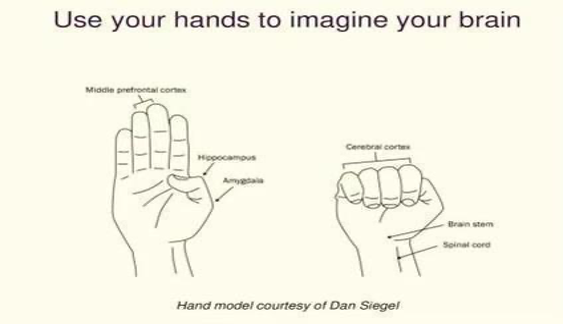
I love Daniel Siegel’s works on interpersonal neurobiology, a field that helps us understand the mind and mental health. Dr. Siegel’s hand model of the brain structure, is shown in Figure 4.1
The fingers represent the prefrontal cortex: our thinking, rational, and emotional brain. The thumb represents the limbic system deep within the mid-center of the brain. This part of our brain reacts under stress, limiting activity in the prefrontal cortex. When this happens, our brains are “offline”, and we lose the ability to think constructively and positively and instead operate from a place of high emotion. Shame takes over, and you have lost your full potential to connect to the highly functional, rational, thinking brain. In that state, you are unable to give your very best to your partner. It never goes well when both of you have a “flipped lid.”
The flipped lid—as Siegel refers to a brain offline (the image where the four fingers are up and not cupped over the thumb/limbic system) — is a reaction from the limbic system; it screams, “Danger!” It senses a threat to your mind and body. You temporarily do not have full access to your rational and thinking prefrontal cortex, which allows you to process and reflect on incoming information. Knowing your makeup and how you’re put together is essential, as well as a basic understanding of what “flips your lid.”