
Jack learned at a young age that feelings were not safe to express. He couldn’t be authentic with his feelings without shame reminding him, “Only sissies cry, so buck up.” The internal voices of criticism and shame became loud enough that his “managers” could no longer hold back, and his “firefighters” came to his rescue. One day, he found his dad’s pornography stash in the bottom of a dresser drawer while hunting for a jackknife. At eleven, he had never seen anything of this sort. His curiosity got the best of him. He hid one under his shirt while ensuring the rest remained in place. Jack would get lost in the hours of combing through the magazine, losing track of himself and time. He eventually got good at trading one magazine for another in his dad’s drawer and spending more and more time in a world of fantasy. This world kept the feelings and thoughts from crossing over and reminding him of how worthless he felt.Emotive Behavior. He viewed our negative thoughts as coming from our irrational beliefs about ourselves and others. In his book A Guide to Rational Living, Albert Ellis states that, “people often ‘awfulize’ or ‘catastrophize’ turning small setbacks into unbearable disasters in their minds.”[1]
[1] Albert Ellis, A Guide to Rational Living, (Wilshire Book Company, 1975), 35
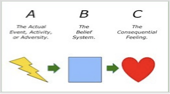
Change Your Beliefs, Change Your Feelings Understanding feelings is half the battle. What you tell yourself when a specific event or action takes place will affect the outcome and experience you feel as well as how you move through the situation. Figure 4.2 is a flowchart from the multimedia editor of the renowned psychologist Albert Ellis, showing his ABC model of how events filter through our belief systems to impact our feelings. Albert Ellis is the founding psychologist that developed Rational Emotive Behavior. He viewed our negative thoughts as coming from our irrational beliefs about
The actual event activates the belief system, and the belief system stimulates the consequential feeling of believing the messages you’re telling yourself about the event. For example, you may come home from work and find your front door locked, and after trying to unlock it a few times, it still doesn’t open. This is the “Actual Event” in Ellis’s model.
Then we have the “Belief System” that kicks in and says: “She changed the locks, I knew this would happen, she’s going to leave me, I’m not worth staying around for, I’m not trying hard enough, I’ll never be good enough.”
Then we have the “Consequential Feelings.” Thinking and believing the messages you are telling yourself are followed by Consequential feelings of fear, shame, anger, or sadness. It all traces back to the belief system. What we tell ourselves and believe about it makes a big difference in how we react (or not) to the activating event.
In 2020a study by Nature Communications, was done in Canada that used brain imaging to track our thoughts.They found that we have an estimated 6,200 thoughts per day. The National Science Foundation in 2005 stated a much higher finding 12,000to 60,000 thoughts per day and up to 80% being negative thoughts. Will you allow negative thinking to take over? Or will you replace the negative thought with a healthy, realistic, positive thought?
One of my professors in college recommended adding D-E to the A-B-C model to help us remember how to change the beliefs that result in our negative thoughts and feelings.
- D- Dispute the Belief system: “How do I know she changed the lock? It could be just a coincidence.”
- E- Exchange the negative thinking: “I am good enough; I am working hard to repair and work on myself and relationships.”
What we allow to run through our brains is highly influential. Pay attention to what your thoughts are and what you say to yourself. Have boundaries over what you allow others to say to you, and monitor what you watch, and listen to. Our brains retain the information we put in it. Also remember your thoughts may originate from specific messages you took on as a child. Practice discernment and allow your wise self to be in charge, rather than the negative, abusive, shaming voices from the past. Dispute the negative messages and replace them with positive thoughts. Know that with every new thought, our brains form new connections and neurons, what scientists call neuroplasticity in the brain.
Question for Your Heart:
How does shame challenge you, and what obstacles get in the way of shame having its way?