
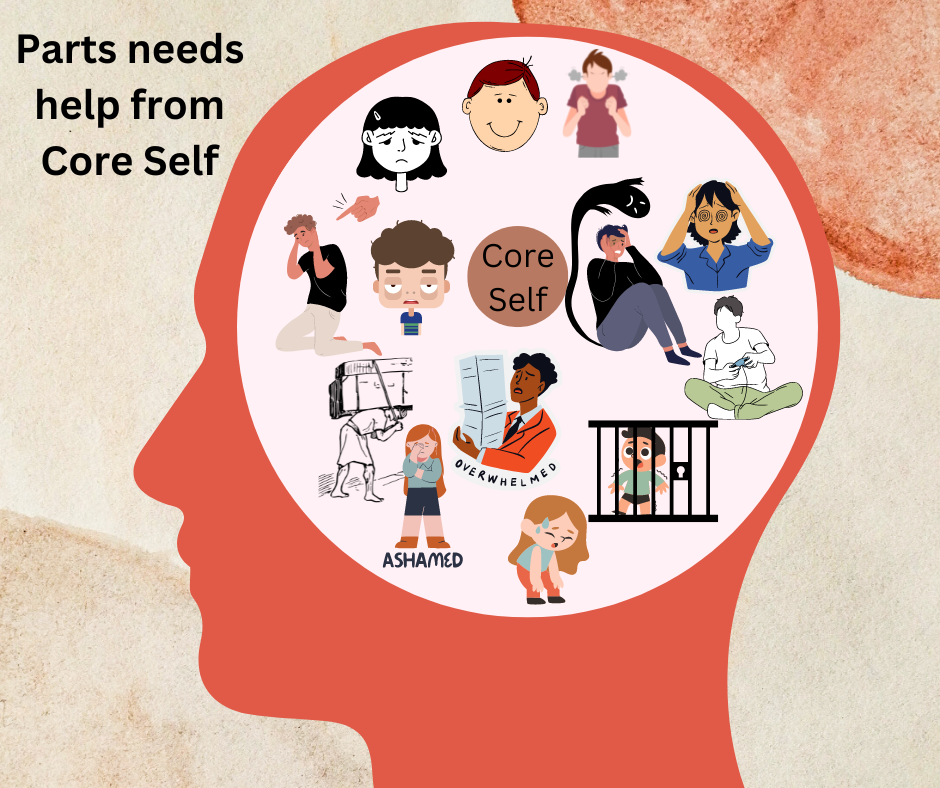
One way to better understand ourselves is through parts work, a theory called Internal Family System, IFS. Richard Schwartz is the founder of this unique modality. “Don’t assume your inner critic is what you think it is… it’s a part of you trying to protect you somehow, and if you can think of it that way, it isn’t going to have the same level of power over you,” Richard Schwartz. According to Schwartz, our ” parts have three primary categories.” Exiles, Managers and Firefighters/Integrative Psychotherapy.
Exiles are the younger parts of self that hold emotions, vulnerabilities, needs, and memories that went ignored, unresolved, and went to “exile” or put away because there was no space to process the needs or the trauma experienced.
Managers are the ones that keep the person “going.” They help put the exiles aside so that the functioning part of the self can go on with life. Managers can be healthy or unhealthy. Being able to compartmentalize is a good manager skill, but constant pressure or perfectionism is a burdened form of management that adds stress.
FireHighters are extreme versions of “managers”; they act more impulsively and become desperate to make any pain or hurt disappear. They might present with addictive behaviors, completely shutting down {dissociating and disconnecting from self and others} or self-destruct. All this is to keep “exiles” away, fearful of what will emerge if they arise.”
Your shame is a held emotion that cannot be felt, talked about, or owned. It’s too vulnerable of a feeling to allow itself to be exposed. It may be that as a child, you heard the message in your head, as in what you told yourself, or even in real life, what you were told. “I’m not good enough, I will never be as smart as my brother, you should be ashamed of yourself, you’re naughty, you’ll never amount to anything, you’re just a silly little crybaby.” We are most vulnerable to this type of toxic shame as children. It brings up feelings of embarrassment and inadequacy. It only takes hearing these messages over and over in humiliated, defensive, fear of being judged or rejected. What is your knee-jerk reaction? Do you want to hide, run, collapse, apologize, get defensive, or run to any one of the addictive behaviors that you use to escape? I challenge you to slow down, welcome the intruder, and kindly speak to these parts of you; honestly, they believe they’re doing you a favor. So when fear shows up, tell it to step aside; you’ve got this, the wise you, because fear can be emotionally crippling when the hippocampus brings up a stored memory of a specific event that has createed any kind of distress in your life.
I